June 9, 2026

Ep. 099 - What the Bible Really Says About Paying Taxes

Few things trigger frustration more quickly than seeinghow much money is withheld from a paycheck or writing a large check to the IRS.For many people, taxes feel like a loss. They represent money that could havebeen saved, invested, spent, or given elsewhere. It's no surprise that taxseason often brings anxiety, resentment, and even anger.

But what if Scripture calls us to view taxesdifferently?

While the Bible doesn't tell us to enjoy every aspectof paying taxes, it does provide a framework that can transform ourperspective. Rather than viewing taxes solely as a burden, Christians arecalled to see them through the lenses of stewardship, gratitude, obedience, andtrust in God's provision.

Show Notes

Why Taxes Feel Different

When we purchase groceries, a meal at a restaurant, or a new appliance, we see a direct exchange. We give money and receive something tangible in return. Taxes often feel different because the benefits are less visible. We don't typically connect our tax payments to roads, infrastructure, emergency services, national defense, or other public services we use every day. As a result, taxes can feel like money disappearing into an impersonal system.

That disconnect can make it easy to focus on frustration rather than gratitude.

What Romans 13 Teaches About Government

One of the clearest passages on government authority is Romans 13. In this chapter, the Apostle Paul teaches that governing authorities exist because God has permitted them to exist.

This doesn't mean every government is perfect or that every policy is wise. In fact, Paul wrote these words while Christians were living under the authority of the Roman Empire—a government known for corruption, persecution, and hostility toward believers.

Yet Paul's instruction remains clear: Christians are called to respect governing authorities and fulfill their obligations, including paying taxes.

The command wasn't based on agreement with government policies. It was based on obedience to God.

Paying Taxes Is Not the Same as Endorsing Everything Government Does

One common objection Christians raise is that they don't want to support programs or policies they disagree with. That's understandable. No government perfectly reflects biblical values.

However, paying taxes is not an endorsement of every governmental action. It is an act of submission to the authority structure God has established.

At the same time, believers living in representative governments have opportunities to vote, advocate, communicate with elected officials, and pursue positive change. Paying taxes and seeking reform are not mutually exclusive.

Stewardship Is Not Tax Avoidance

The Bible encourages wisdom and stewardship. Good financial planning matters.

Using legal tax strategies, charitable giving tools, retirement planning opportunities, and other tax-efficient approaches can be wise stewardship of the resources God has entrusted to us.

However, there is an important distinction between stewardship and avoidance. Stewardship seeks to honor God with financial resources. Avoidance is often driven by resentment, fear, or a desire for control.

The motivation matters. A believer can pursue wise tax planning while maintaining a grateful and obedient heart before God.

What Jesus Said About Taxes

When religious leaders attempted to trap Jesus with questions about taxation, His response was both simple and profound:

"Render to Caesar the things that are Caesar's, and to God the things that are God's."

Jesus refused to turn taxes into a political debate. Instead, He redirected attention to a deeper issue: ownership.

Ultimately, everything belongs to God.

Every dollar we earn, every investment we make, and every asset we accumulate exists under God's authority. When we recognize that truth, taxes become less about what is being taken from us and more about faithfully managing what has been entrusted to us.

Gratitude vs. Resentment

Perhaps the most important issue discussed in this conversation is the condition of our hearts.

There are two very different ways to approach taxes:

Resentment says:

  • This money is being taken from me.
  • I shouldn't have to pay this.
  • I need to keep as much as possible.

Gratitude says:

  • God has provided for me.
  • I have income because of His blessing.
  • I can trust Him to continue providing.

Neither perspective changes the amount of tax owed. But each perspective profoundly shapes the condition of the heart. A spirit of resentment often spreads into other areas of life, creating anxiety, scarcity, and discontentment. Gratitude, on the other hand, cultivates trust, generosity, and peace.

A Tax Bill Can Be a Reminder of God's Provision

No one enjoys writing a large check to the IRS. Yet there is a sense in which paying taxes can remind us of something important: taxes generally exist because income exists.

The ability to pay taxes is often evidence that God has provided resources, opportunities, employment, business success, or investment growth. Rather than focusing solely on what is leaving our hands, Christian scan choose to remember the God who first placed those resources there.

The Real Issue Is the Heart

At the end of the day, taxes are not primarily a financial issue. They are a heart issue. The way we think about taxes often reveals what we believe about ownership, control, trust, gratitude, and God's provision.

Wise stewardship matters. Good tax planning matters. But even more important is maintaining a heart posture that reflects trust in God's goodness and faithfulness.

As Paul wrote in 1 Timothy 6, believers are not to place their hope in the uncertainty of riches, but in God, who richly provides us with everything to enjoy.

When we keep our eyes on the Provider rather than merely the provision, even something as frustrating as taxes can become an opportunity to grow in gratitude and obedience.

Questions for Reflection

  1. What emotions do you typically experience when you think about     paying taxes, and what might those emotions reveal about your heart?
  2. Do you view your income primarily as something you own or something     God has entrusted to you as a steward?
  3. How can you pursue wise tax planning while maintaining a spirit of     gratitude and trust?
  4. In what ways has God provided for you financially that you may be     overlooking?
  5. Are there areas of your financial life where resentment, fear, or a     desire for control has begun to replace trust in God's provision?

Bible Passage: 1 Timothy 6:17 (ESV)

17 As for the rich in this present age, charge them not to be haughty, nor to set their hopes on the uncertainty of riches, but on God, who richly provides us with everything to enjoy.

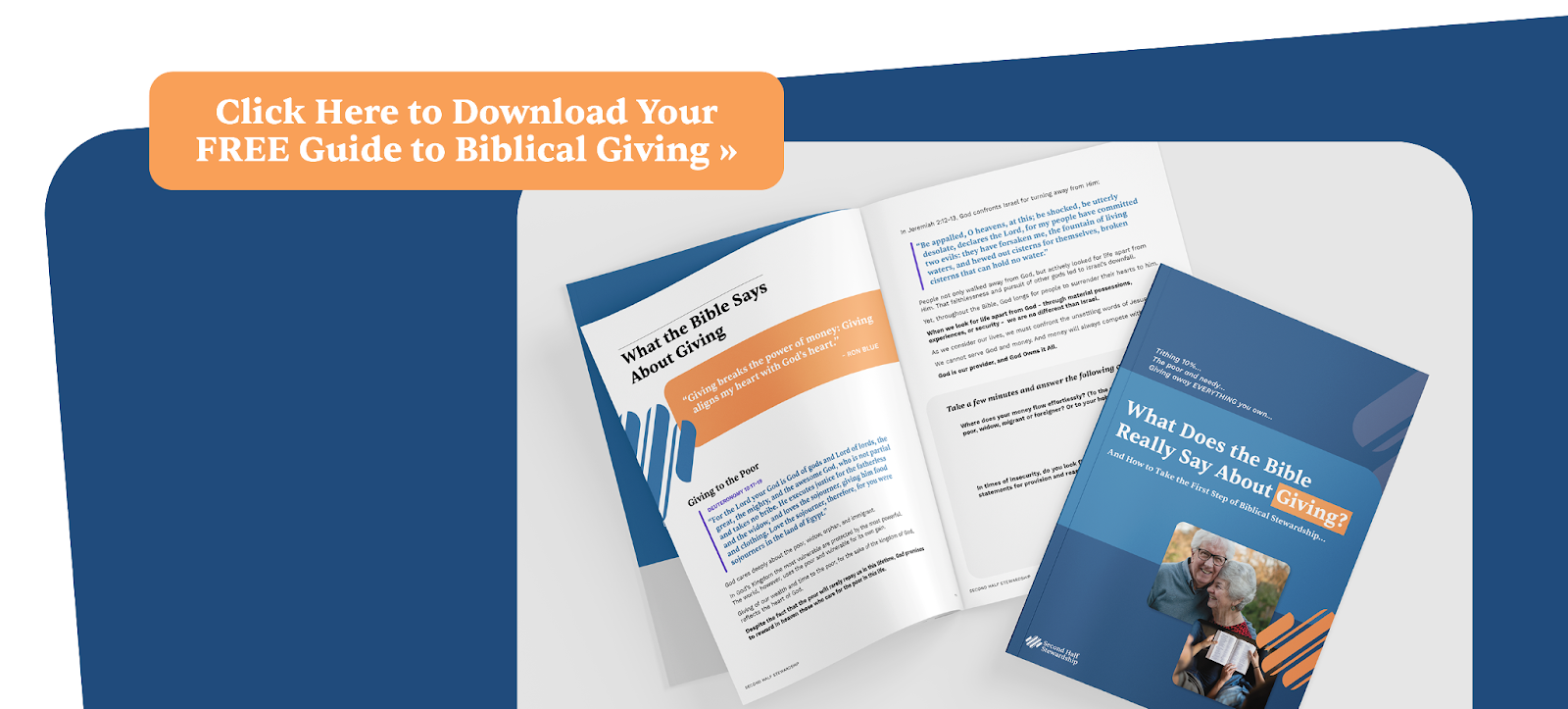
Want to Take the First Steps of Biblical Stewardship?

Download this free guide to Biblical giving and we’ll unpack what the bible says about tithing, giving to the poor,
or giving away everything you own for the sake of the Kingdom.

Links

Ep. 099 - What the Bible Really Says About Paying Taxes

0:00

Episode Transcript

Austin

Few things trigger frustration more quickly than seeing how much money is withheld for taxes. For many Christians, taxes feel like loss. Money wasted, misused were taken unjustly. But Scripture invites us to see taxes through a very different lens, not merely as a burden, but as evidence of God's provision and his ordering of the world. Today we'll explore what the Bible actually teaches about paying taxes and how gratitude, trust, and faithful stewardship can transform the way that we write that. Check to the IRS. So, Spencer, today we get to talk about the joy of paying taxes. And yes, dear viewer, I said that right. The joy of paying taxes. And so when we think about we are, as Christians, called to honor the authorities that God has placed in our lives. That does include governmental authority. So today let's talk about taxes. And why do we start with the heart of the joy of gratitude, of paying taxes?

Spencer

Well, I think it's the opposite of actually the fall in some ways. And I was reminded of this in a conversation with my 15 year old daughter this week. I had shared, you know, we're in the midst of writing a check to the IRS for, quarterly taxes. And I had shared the amount and her jaw dropped and she said, that's outrageous, dad.

So I think it's just in a we we just were born and we just we feel like we pay too much in tax. You know, whatever it is, we can we can kind of all get behind. That is maybe the emotional response that we have without a biblical worldview to, paying that tax bill.

Austin

Yes. Well, and I think about it in terms of things that I go and I buy every day. If I go buy groceries, I see there is an exchange of I am giving you money and you are giving me food. I like paying you money so that I can have food. We don't think every time that we turn on our spigot that there is a city utility who's behind that tax that we are paying to help clean the water, or we don't think about the fact that I drive on a road and that road needs to be maintained, or that there are police or military or all these other facets of our daily life

that I don't pay directly. I don't go to a police officer or I do pay my city utilities, but I don't see some of the tax benefits that utility garners. And so when I pay the taxes to the IRS, sometimes it feels like an ambiguous entity that I don't know what I'm getting. And I think that's part of where that is.

Like, whoa, that's bogus. Why are you paying that much in tax comes from is because there's oftentimes with so many other pieces of our lives, there's an actual exchange of goods and services that I can see rendered where with government, I may not see it as clearly on a day to day basis.

Spencer

Well, and most of us are not CPAs, you know, most of our clients, they have an understanding of how taxes are calculated. But when we really get into the nitty gritty, there's always some aha! moments. And so, hell hath no fury like a client who gets that tax bill. You know, and there's an extra $5,000 that has to be paid because maybe there were some extra dividends, or there was the sale of a home or something came up and, you know, a life insurance policy was cashed out or whatever it might be, or they.

Austin

Made more money than I thought.

Spencer

They did. They made more money. All those kinds of things can lead to having to pay some, you know, when, at the very end of the year and a level of sticker shock. And to your point, it's not as though we just say, oh, well, yeah, that trip to Costco was there was $50 more than I thought it was going to be, because we got a few extra things in there.

And yeah, I made some decisions in there. Now it's it's just we receive the bill and, and we feel like, oh, I had no choice in this. I've just got to pay it.

Austin

Right. Right. Well, I think some of those common reactions, we think about them kind of at an aggregate the some things that we may say, this is reasons why we don't like paying taxes. Some common of these reactions the government waste money. So therefore they don't deserve mine or I'll give to God. But I don't want to fund something I disagree with.

Right. Or avoiding taxes is just smart stewardship. And I'll say prudent tax planning is smart stewardship. But avoiding paying your taxes is illegal, right? And so let's draw a line here. We can be prudent. We can be wise stewards. We we want to try to level our tax bill as close as we can to what I pay, either in estimated payments or through withholdings in my paycheck.

I want to try to get as close to zero so that I'm not giving it a loan to the government through the year. But stewardship is not avoidance, right? And so when we think about this, taxes really reveal what we think about ownership, what we think about control, what we think about in terms of trust. And Tim Keller often reminds us that greed, it often is that one that drives our hearts and our minds to a place where it feels like we are.

We can be deceptive. If I can just do this, this, or this, maybe I can fudge the numbers a little bit here so that I can keep a little bit more in my pocket and less from the IRS. No, you can again be a steward, but not let's not try to be greedy and take control and take ownership, because I think at the end of the day, wherever you fall on the political spectrum, there is going to be something about the government that they do that you enjoy.

No matter where you fall. Whether it is Social Security benefits or Medicare or Defense or whatever it is. There needs to be some level of an institutional, appreciation that we come back and say no, it needs to flow out of a place of I trust the Lord. He has given me income. Therefore, I can say with joy, thank you, Jesus, that I get to pay this bill because you have provided for me.

And that's the turn that we need to start making. So when we look at this, when we look at Romans chapter 13, we're not going to read all the verses 1 to 7. But there's some key concepts in here that we can come out with. And the reality of there is no authority except from God. And God is the one who places the authorities over the nations that we live in.

He is the one, whether it is a just government or an unjust government. He has still placed them in these locations. I think about our brothers and sisters in Iran. The church in Iran is flourishing right now, and it's an oppressive government against a government that is killing a subset of their people because they're protesting against the government.

And yet our brothers and sisters in Iran are flourishing and praying for a just government there. They are under an oppressive regime, and yet they have still come and said, hey, we want our land to flourish. We still trust in the God of the universe that he's placed these people over us. And yet we can pray for change.

We can long for change. And I think when we look at it in the West, we don't have that type of oppressive government that's looking to kill a subset of our people. But I think we can take heart that Paul, when he was writing this letter to the Romans, it was more of an Iranian style government where the the, the regime is oppressive and persecuting Christians, putting them to trial and to death.

And yet Paul still exhorts them to say, pay your taxes, submit to that authority. Yeah.

Spencer

You have emperors who are lighting literally lighting Christians on fire in their yards. Yeah. This is not anything that is, normative, you know, in the West. Yeah. And yet we so easily have our hearts turned to to to be grumbling. You know, with this now, again, all the principles that we've talked about, they still apply where you're probably getting tired of us.

If you're watching our financial planning overview videos, talk about things like qualified charitable distributions and avoiding income related Medicare adjustment amounts, those surcharges, all those kinds of things, we still are going to focus on those because we'd like for you to be able to give away more on the balance. Yeah. However, we get to this point and really it is a reflection of our heart that we need to pay attention to.

Austin

Absolutely. Well, I think the reality here, if we come back to look at Paul's language in Romans 13 and honoring the institutions that God has placed over us is about obedience to God. In a lot of ways, paying taxes is obedience to God, because if he is the one who has instituted these powers, you know, we look at the metanarrative scripture, the reality of the principalities that control this world.

There may be dark powers that are controlling those, but God is still the authority over them. And we still must obey God as our first authority. So we pay taxes because we are obedient to Jesus, not because we endorse the policies of the government. There are going to be policies that we disagree with, and they're going to be policies that we should write to our lawmakers and say, this is an anathema, and you should try to obliterate it.

There are absolutely those things. And thankfully, in the West, we not only pay taxes, but we can vote in such a way that we say, you need to do something about this, right? You can write letters to your senators. Thankfully, anytime that I've done this written in emails, a lot of times they respond and they say, yeah, you're right, that is an anathema.

Austin

We need to deal with modern day slavery. We need to deal with some of these horrible things that are happening, but that's part of it. If I'm not paying taxes, if I'm not voting, that I cannot participate with those institutions that God has given us authority over me. So we are obeying God. And I think we look at this and we continue to come back to that idea of when we pay taxes, it is a sign that God has provided income for us.

Whether you are in a state, a country, in a city that has a high income tax, whether you are in the 12% bracket or the 37% bracket, the higher you go, the more God has provided for you, so the better. You should rejoice in the Lord as your provider. As you are writing that uncomfortable check and it's still going to be uncomfortable.

There's no way to eliminate that discomfort. But in obedience and enjoy, we can say thank you Jesus, for for doing this for me. Thank you for providing for me.

Spencer

Right. Well, and it's a little bit different now than in ancient times, because in ancient times you often had a regressive tax where you actually had the poor people who were taxed at a higher percentage level and the wealthy were given special privileges. Now there would be some that would say, oh, well, that's, you know, same as modern day, actually, no.

There, even if you object to the carried interest that, you know, private equity, you know, managers get oftentimes they're still paying tax. They're maybe not paying as much as they should. But most folks who have, you know, that million dollars or more in terms of their income, they're paying a higher marginal rate. You may not think that they're paying enough, but they're still paying more than you know.

Most people aren't there. In ancient times, that was often not the case at all. You had you had a regressive tax and you had a tax just for showing up in life. You know, you had these temple taxes that, you know, if you want to show up and go to the temple, hey, you got to pay this. You know, it doesn't matter who you are.

Here's here's the amount you got to pay. That's that's pretty punitive, compared to what we find. Where, you know, we really can rejoice. The more income that we have, the more taxes we're going to pay. And that's just the way that it.

Austin

Is, right? Absolutely. Well, I think that's the you know, if we come back to it and see how Jesus interacts with people when they bring him questions about, okay, this coin, do I render it to Caesar or to, how do I deal with this? And, you know, taxes as an institution, government and as an institution, the United States government is a neutral institution.

Whether we want to say it's further left or further right, taxes within that and within that government entity are morally neutral. There's not a morality that we can say, well, taxes are bad or wrong or evil. They're part of the government and the institution that God has set. When we look at the trap that's being laid, Jesus is the Pharisees were trying to say, okay, either you betray Israel or rebel against Rome.

They're trying to trap him and say give us a moral compass on this argument. And he says, no, I'm not going to do that. Render to Caesar the things that are Caesar's in the guise of things that are gods. He puts us back in a context where we start to have to think, okay, there isn't a morality that we can say on this, but there is a stewardship that we can place on this.

How am I thinking about the things that are God's, which is everything, every dollar that he's put in my hand is going to show. How do I believe what I believe about God?

Spencer

Well, I love that we come back to the stewardship principle because there are people, who we have encountered, who they will spend 50 hours trying to reduce their tax bill by $50. Their time is worth more than $1 per hour. So, you know, we need to look at this from a stewardship standpoint. Yes. Do I want to do the simple things like, you know, use qualified charitable distributions or make sure that I clump and bunch using a donor advised fund or things that big picture they once once we do them once or twice.

We've got that rhythm. We've got that cadence. Maybe we can lower our tax bill by thousands of dollars. Great. Yeah. We don't want to be, you know, again, my my, my my thought would be you don't want to be recording every receipt that you have out there to record the sales tax, generally speaking. Just so that you can tally that up to see if you might itemize, you know, in that given year, I mean, if you need something to do, okay.

But generally speaking, putting that much time into something the Lord could call you to have an impact in far greater ways, and being able to give of your time, you know, in other areas. So that's where we come back and say, you know, yes, let's try to reduce taxes. Let's try to be great stewards. But it's within that lens of I've got time, I've got financial resources, I've got relationships there.

There are overlap in there where if I take too much of my time, you know, even if I'm able to get to save a few pennies, it's not going to be worth it. Right?

Austin

Well, I think we come back to this idea of what are two different postures, what are two different heart level postures that I can take towards tax. And I think the one that drives us to I'm going to itemize everything. I'm going to take every record. I'm going to spend the next 50 hours to save. $50 is one that's either driven by it's often driven by resentment.

I resent the government, and so I want to keep as much money out of their hands as possible. And so what we do is say, this is taken from me. These resources have been taken out of my hands unjustly, which maybe there's an argument you can make there. But is our heart resenting the government, or are we saying we're thankful, Jesus, that you have given us leaders?

That's gratitude. When you think about oftentimes this posture of resentment can lead us to a fear of loss. I shouldn't have to pay this. I shouldn't have to lose this money, gratitude says. I can recognize that I've been provided for. Resentment causes us to try to take control. It causes us to try to say, what can I do to reorder my life?

Take all the time that I need to be able to make sure that the government does not get another $0.03? It's I'm trying to control versus gratitude says, how can I trust the Lord? And do I want to pay another $5,000 in tax? No. Do I want to pay another $10,000 in tax? No. But again, if God has entrusted this wealth to me and it is a sign of his provision to me, I can say thank you, Jesus.

I trust you to continue to provide, even if I have to write this check. Right. So as we finish out, we need to start thinking again. How do we clarify this? Avoidance does not equal stewardship. Trying to avoid our taxes doesn't equal stewardship, just like wisdom doesn't equal rebellion. And that means yes. To your point, when we look at tax planning with clients, we may spend hours helping them generate a tax plan.

But some of that is how am I guiding your heart to love the Lord? A lot of our tax planning comes back to you for clients. Hey, are there ways that you can give more every dollar that you give out of a QCD If you're at RMD age, it knocks how much you paid to the federal government if your sole goal is one.

I don't need these resources because my Social Security or pension or lifestyle is just one where I don't need the resources. Well, if you don't need them and you want to not pay as much in tax, why don't you give them to an entity that you love and you cherish and you want to see them thrive? We're not avoiding tax in that regard.

We're saying, let's be a steward of these resources that God has placed in your hands and and do it wisely, right. We love the QCD because it reduces dollar for dollar that RMD that you've got to take into your pocket and then pay tax on. So if you can QCD the entirety of your R&D and not pay anything to the federal government, and that satisfies your desire to both give charitably and to avoid taxes or to not pay unnecessary tax, then why wouldn't we take that stewardship step?

Right? I think these are the things where we're saying it's not. We're avoiding because we distrust and we resent the government. It's saying, hey, there's actually really nice benefits that I can make these charitable gifts. I can give back to the Lord what was his in the first place. And I don't have to pay quite as much in tax because of it.

I can reduce that bill that I have to pay and still be a generous steward of those resources that God has placed in my hand. So, Spencer, really, at the end of the day, what's at stake if we are not seeing this wisely as stewards of these resources that God has placed in our hands, but as someone that is trying to control that, what's the risk?

What's at stake?

Spencer

I think the biggest thing that's at stake is just the heart posture that we have as stewards. And this may sound, you know, nebulous or difficult to kind of pin down. But if we start each day or if every time we pay, taxes to the government, if our heart is grumbling, we're setting ourselves up for a whole, a whole worldview, a whole perspective that we just infect people with.

You know, there's this level of grumbling that is a lack of gratitude. And we see this going back, you know, to ancient Israel, you know, the the key reason that Moses had issues with the Israelites was these grumbling hearts that they seem to continually have. And yet we do the same thing over stuff that's far more minute. You know, you think about having to pay an extra few thousand dollars in tax versus not having water, you know, to drink.

That's that's readily there. And I think that my sin is much higher if I'm grumbling over the thousands of dollars of tax that I've got to pay. Because at the end of the day, I have those resources, you know, I've earned those resources. There's there's money to pay those taxes if I haven't gone and spent all of it.

Right. So that's a that's a whole nother thing that, you know, we've talked about in terms of lifestyle and debt and, and, living expenses. But I think that heart posture, if we can come back to each morning starting off the day with gratitude and we can have that perspective that joy through the day of gratitude, of what the Lord's done, and even to the point that paying taxes doesn't impact that, then our hearts are really on a good path towards the Lord.

Austin

Absolutely.

Spencer

So I think I think that's what's really at stake. And so much of the way that we look at money can be colored by the way that we look at taxes. You know, if if we're just trying to kind of hold on to as much as we can. And maybe that starts from a tax standpoint that we just say, oh, I don't want to I don't want to pay the government.

I don't want to give any more than I have to. And I'm just really trying to cling to this that really can fester, that heart posture can go into the way that we save, into the way that we look at just scarcity. Instead of saying, okay, yeah, I'm going to do my best here, probably going to miss some things every now and then.

But I'm going to, to try to be able to give away as much as I can. I'm going to try to be a good steward. This is part of that. Probably make some stakes that every, every few years, something that maybe I just didn't realize, you know, what have you, things are going to arise, you know, that we don't kneel perfectly.

But if generally speaking, we're looking at this from a stewardship standpoint and we're doing a good job as stewards. Then that gratitude, even in this part, can emanate from us. And I think it just bleeds into everything else that we look at in terms of what we touch financially.

Austin

Absolutely. So we'll end today with Paul's charge to Timothy, and it's in ten 1 Timothy 6 and he says, charge them. He's talking about the wealthy in the congregation. And we hear wealthy don't think modern day wealthy think ancient Israel wealthy. We are wealthy today.

Spencer

Well, and we think about that particularly over the the scope of the world that we live in. You know, the clients who we serve, all of us are wealthy, basically all the all of, those who work in the profession and are serving clients in this space, all of our clients, we would be considered wealthy, both from the writer's perspective, here, Paul's perspective, but also modern day, when we when we look across the world.

Austin

Yes. So he says charge them not to set their hopes on the uncertainty of riches, but on God, who richly provides us with everything to enjoy. So clients, if you have questions about what does it look like to be a steward of the tax bill that you've been given, we would love to have that conversation with you. Until next time, take care.

If you found this episode valuable, share it with a friend and subscribe on your favorite podcast platform so that you don't miss the next episode.

Disclosure

This content was provided by Second Half Stewardship. We are in Knoxville, Tennessee and you can visit our website at www.SecondHalfStewardship.com. The information in this recording is intended for general, educational and informational purposes only, and should not be construed as investment advisory, financial planning, legal, tax or other professional advice based on your specific situation. Please consult your professional advisor before taking any action based on its contents.

But how do we actually become generous stewards?

Join us every other week as we explore what Biblical stewardship looks like regarding our money, time, relationships, gifts, and experiences.

Plus, get our complementary guide to Biblical giving, and answer the question: “What does the Bible really say about giving?”

Sign up for updates

Thank you! Your submission has been received!
Oops! Something went wrong while submitting the form.