July 21, 2026

Ep. 102 - What Is Your Portfolio Really Funding? The Christian Investor's Dilemma

Most investors ask the same questions: What's the expected return? How much risk am I taking? How long should I stay invested? These are important questions. But for Christians, they aren't the first questions we should ask. Scripture invites us to view money differently than the world does. Instead of seeing wealth as something to maximize for our own security, the Bible teaches that everything we have belongs to God. We are simply stewards entrusted with managing His resources faithfully. That shift changes everything—including how we invest.

Show Notes

Every Portfolio Tells a Story

Whether we realize it or not, every investment reflects a set of values. The dominant story in modern finance tells us that the primary goal is to maximize risk-adjusted returns. Success is measured by growing our wealth as efficiently as possible while managing risk.

A biblical story begins somewhere else. Rather than asking, "How can I earn the highest possible return?" Christians are called to ask, "How can I faithfully steward what God has entrusted tome?" Those may sound like similar questions, but they often lead to very different conclusions.

Jesus Warned About Two Masters

In Matthew 6:24, Jesus gives a sobering warning:

"No one can serve two masters... You cannot serve God and money."

The word translated as "money" is mammon, referring not merely to wealth itself but to the spiritual pull that tempts us to place our trust in financial security instead of God.

That temptation doesn't disappear simply because we're investing rather than spending. If our investments are driven solely by the pursuit of higher returns, we may unknowingly adopt the world's story instead of God's.

What Are You Profiting Alongside?

One of the most challenging questions raised by Christian investing is this:

Where do a company's profits come from?

Many businesses create products and services that genuinely improve human flourishing. Others generate significant profits by exploiting addiction, encouraging destructive behaviors, or profiting from practices that harm people made in God's image.

As investors, we become partial owners of the companies we invest in. While our ownership may be small, it's still worth asking whether we are comfortable participating in the way those businesses create value.

This isn't about legalism or trying to find a perfectly pure investment. In today's economy, many companies operate in complex ways. Instead, it's about developing discernment. Christians should care not only about how much they earn, but also about what their capital is supporting.

Faithfulness Before Financial Performance

The financial world teaches us to evaluate investments primarily through three factors:

  • Risk
  • Return
  • Time horizon

Those are valuable considerations, but they aren't ultimate considerations. For Christians, faithfulness comes first. The greatest risk isn't necessarily earning a lower return. It may be failing to steward God's resources in a way that honors Him.

Likewise, our understanding of return changes when we recognize that God owns everything. Financial growth matters, but eternal faithfulness matters more. And our time horizon extends far beyond retirement. Christians live with eternity in view.

There Is Wisdom in Discernment

Not every investment decision is black and white. Many companies provide products that can be used for tremendous good while also existing in a fallen world where those same products may be misused. That reality requires wisdom rather than simplistic answers.

Some investors may choose to screen out entire industries. Others may seek companies that actively promote human flourishing. Still others may engage through shareholder voting and corporate accountability. Faithful investing isn't simply about what we avoid. It's also about intentionally deploying capital toward businesses that contribute to the flourishing of people and communities.

Stewardship Is About More Than Performance

Ultimately, investing is not just about building wealth. It's about stewardship. Every dollar we invest is an opportunity to participate in shaping the world around us. As Christians, our goal is not merely to outperform a benchmark or maximize returns. Our goal is to honor Christ with every resource He has placed in our hands.

When we begin with the truth that God owns it all, our perspective changes. We are freed from placing our hope in financial performance and instead can pursue faithful stewardship with confidence that God will provide exactly what we need.

Questions to Consider

  1. When I think about investing, is my primary goal maximizing returns or faithfully stewarding what God has entrusted to me?
  2. Have I ever considered what businesses and industries my portfolio is actually funding?
  3. Does my investment strategy reflect my biblical convictions, or has it been shaped primarily by the world's definition of success?
  4. How might my investment decisions change if faithfulness became my primary measure of success instead of financial performance?
  5. What practical steps can I take to better align my portfolio with God's purposes and the flourishing of others?

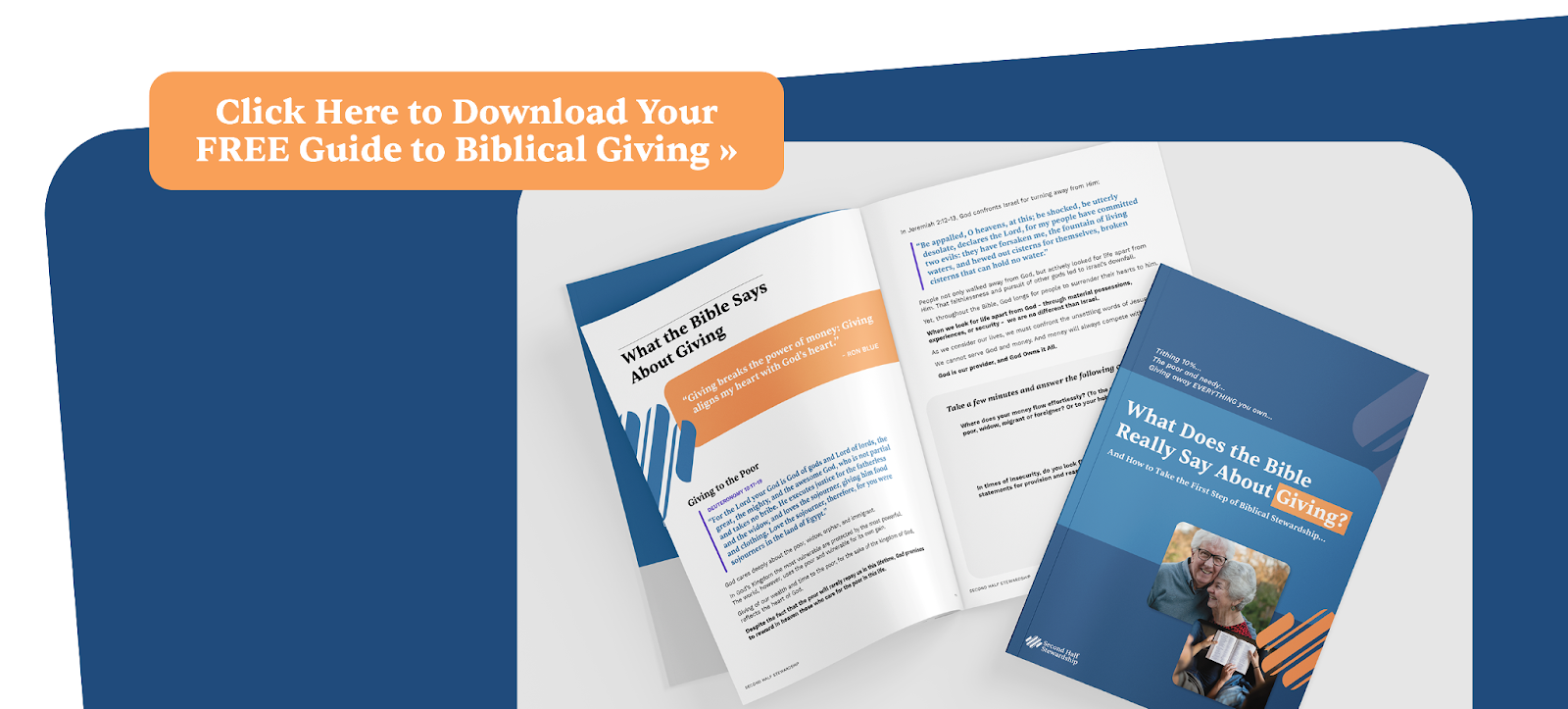
Want to Take the First Steps of Biblical Stewardship?

Download this free guide to Biblical giving and we’ll unpack what the bible says about tithing, giving to the poor,
or giving away everything you own for the sake of the Kingdom.

Links

Ep. 102 - What Is Your Portfolio Really Funding? The Christian Investor's Dilemma

0:00

Episode Transcript

Austin

Every investor, whether they realize it or not, is living inside a story. One story says the purpose of investing is simple maximize risk adjusted returns so that we can feel secure, in control, and successful. The other story. Scripture story tells us that money is a tool entrusted by God to cultivate life, bless our neighbors and participate in his restoration of the world.

Today, we're going to explore these two competing narratives and ask a deeper question. What story is your portfolio telling?

Spencer

It was the best of times. It was the worst of times. A Tale of Two Cities, a tale of two portfolio trajectories today and it's going to be a fun, I think, podcast because we really get to dive into these competing narratives, and we see this really played out in a lot of different ways, but I think in ways that maybe it's not something that comes to mind when a lot of people think about competing narratives.

The Christian narrative and say the secular narrative. We often think about that in other parts of life, but not this one. Why do you think that's the case?

Austin

You know, I think about like some of the other broad narratives, whether it's sex or greed or some of these other things we as a Christian have looked in holistically through Scripture. There are commands or mandates that say, do this or don't do this. But I think in some ways we have chosen the path of, some of the Old Testament, kings where they intermarried and just said, well, this is what the world says.

Scripture is kind of vague. It didn't really tell me how to buy or sell companies. So I'm just going to take the world's story where I think with some of these other things where God very clearly says, don't do this or do this. We as Christians can look at it and say, okay, well, I'm not going to do that or I'm not going to participate in this, but this is one of those areas where we've just taken whatever the culture says is and said, okay, I'm going to take that.

I'm going to buy it. I like it, it sounds good. And I think at the end of the day, it's because it comes down to I have an uncertain future. And how do I deal with my anxieties about an uncertain future? If there's there's certain things that we can't control about public markets, there's things that we can't control about the companies that we invest in.

And so, because that future is uncertain, I can't change necessarily that direction where I can choose maybe who I date, who I marry, I can choose what I buy. Those are things I have control on. Where maybe in an investment world, I don't have full control over the future. And so let me just take the world's path, which says maximize risk adjusted returns.

Spencer

Well, and you highlighted there's anxiety there and there's complexity and any study would suggest that when you have a high level of emotion and you have a high level of complexity, you're going to end up with decisions oftentimes that are suboptimal. And certainly in this case, with the anxiety, these emotions, they're going to taint the decisions that we make.

But really it's the complexity. It's the layers that we have between making the investment and then actually seeing some of the results. So, you know, you can invest in an S&P 500 index fund, pick one of many that are out there and you might not know. Okay. I'm investing in a casino. At the same time, you know, most Christians, they're not going to go in and say, okay, I'm going to be, spending my week on vacation in a casino that's going to be different than their core values.

They're going to be antithetical because, you know, intuitively what goes on in the casino, even beyond just the gambling piece of it, is not healthy. It's not, leading to flourishing and fullness of life. Particularly as would be, unpacked in the biblical narrative. So there's there's a lot, I think, that we can get into here. But it is really interesting that there's other areas, whether we look at, anything leading to addiction or, you know, anything leading to, you know, sex outside of, you know, God's, definition of of, you know, what would be healthy?

There, we, we tend to be able to avoid much more easily.

Austin

Right? Absolutely. So we'll start here and we'll say Matthew 6:24, Jesus is talking and he says, no one can serve two masters for either he will hate the one and love the other, or he will be devoted to the one, despise the other. You cannot serve God and money, and the word he uses here really is more direct.

You cannot serve God and mammon, and Mammon is the demonic manifestation of the idol that is trying to trying to draw our hearts away from God and trust in financial resources. So Jesus is being very specific. You will have a master that you will swear your allegiance to you. And so you can buy into one of these two stories.

You can serve God or you can serve mammon. You cannot serve God and mammon. There's a very clear delineation. And so I think we have to ask that question. If Mammon is discipling us, what is the story that he is telling us? What is that story that the modern financial world is discipling us into? So let's go ahead and highlight the world story, maximize risk adjusted returns.

So we'll come back to this at the end and talk about how do we think about this from a scriptural perspective. But when you think about risk return time horizon as a good financial advisor, how would you describe those?

Spencer

Yeah. So if I put on my, hat that says, this is what I was taught in the MBA program at University of North Carolina, you've got these three factors you know, in there. You've got risk return and time. So risk. Well, we want all other things equal to have the most, conservative or the least amount of risk that we can, while we're maximizing return over the shortest period of time.

So, you know, we do everything that we can to minimize that level of risk. And that would include decisions that we would want the CEO or the management team to make that would, you know, mitigate any potential for, the company to get hurt. So that could be wise, you know, in terms of the way that they're stewarding that company.

But it also could be things that we might not like, you know, if we're open to actually analyzing this and saying, well, what if, you know, they have business interests that are in a country that doesn't have, you know, quite the same, law set up that ours does. And they know that if they give $1 million here and there that they can bribe officials.

Do we like that? What we're reducing risk. So and it's within, you know, fair play of of what? You know, most firms would do in a particular area, but we would start to get squeamish. You know, their return. We want to see the highest level of possible return, given everything else equal. So low risk, high level of return.

Well, again, there are ways that we can add value within, an economic ecosystem. But some of the ways that you might drive profitability might be in taking advantage of some of those in the short term and then propping up your earnings. Right. Particularly as we're in our culture, you know, you've got these, reports that are issued and oftentimes, you know, calls that are done on a quarter to quarter basis, giving guidance for everything from revenue to, expense to, the level of profitability, the certain, you know, business lines that that the company might have, depending on how big they are, all these different pieces, and it all

goes towards how can we position ourselves to get that maximum level of return over a long period of time? Now? Sometimes, though, it's not even over a long period of time because again, that third piece is how can we shorten the amount of time to, you know, double our revenue or triple our revenue or, increase our margins, you know, the profitability per unit sold or, whatever it might be.

So, you know, we're looking across those three factors. And again, if, if we could choose those in a vacuum where, you know, it's, it's the same moral value of a company doing A and B, then great. The, you know, those three factors are part of the equation. And they're an important part of the equation, you know, but they're not the only part of the equation.

Spencer

And in fact, they're a secondary part of the equation. If we really think about it, I think with our stewardship lens, because we're coming at this from a fundamentally different angle. Right.

Austin

Absolutely. Well, and I think about it too, in that reality of, okay, if I am purely looking at maximizing risk adjusted returns, it's not necessarily that they are sinful, but in if we make that at the ultimate goal, if pure profit maximization is my only goal. And to your point, how I'm getting there, how I'm generating those returns, if I am taking advantage of image bearers of God, if I'm taking advantage of people by by profit derivatives that are things that are enslaving people into sin.

You know, I think about alcohol, tobacco, pornography, casinos, those are things that are they their revenues are derived from keeping people addicted to something. Right. Do I want to profit alongside ensnaring people in addiction. Right. Do I care if a friend of mine goes to a casino? I don't think it's a smart idea. But if he goes and he says I've got $20, I'm going to stop in on my way to Asheville in Cherokee and play a slot machine for 20 minutes.

I think that's a terrible idea, but that's his decision to use his resources. But I don't want to see the his grandmother's aunt or uncle constantly pulling the slot machine, putting coin after coin after coin, day after day, losing all of her life savings because that's where these casinos derive their profit. It's not the well-intentioned person that's like, I want to have fun for 20 minutes with $20.

It's the person that is using every dime of their Social Security check to go in day after day.

Spencer

Well, and that's how they make their money. It's the addiction side. It's it's actually taking not $20, it's 20,000 or $200,000. You know, where the whole goal is to actually bleed them dry.

Austin

Yeah.

Spencer

I mean, you hate to you hate to get that granular, but you look at any of the way that the marketing is done, the way that they follow up with people. It's it's it's really, devastating. And we could say the same thing, you know, on alcohol side of things, we have conversations with clients and they say, well, I don't mind having a drink, and I don't think anybody should, you know, be chastised for having a, you know, drink, from time to time.

You know, but again, the alcohol companies and this was done by an independent study. This is not a Christian study and independent study in, the UK. That showed that what was it, about two thirds of all, revenue and profits for, these companies comes from people who are addicted. Yeah. And so, you know, if you're a company and you say, well, most of our profits and in fact, the significant majority of our profits, if they come from people who are addicted, the way that we become more profitable is we get more people addicted.

Yeah, that's that's just simple math. So it's hard to root for companies, you know, when that is the line of progress there. And it's antithetical. So I think, you know, one of the things that strikes me is we come back to the anchoring that we have for any story. And I think this is the subtle thing.

If we start out and we say risk adjusted return is the place that I'm going to start, and then we take one step over and we say, well, I'm you know, I do recognize that I don't like maybe some of what these companies do. And we, we modify their but maybe we even feel bad because we, we kind of like to have still some of those returns.

Austin

Yeah.

Spencer

We're entering a place there where the foundation is really sand. It's going to shift. It's it's really not based on the strength of the biblical foundation. It's not based on the strength of the gospel. You know, there which is that I don't actually have to have the highest rate of return. I just need to be faithful. Yeah. I have a God who already owns it all, so I just need to be, listening to him, you know, as I do things.

So it's that very different narrative that if, if we really come back to, if we really start at a very different place, we might end up with conclusions that are quite different. Right?

Austin

What as we think about okay, let's talk about the biblical story again. We got we we look at Proverbs chapter one and the the writer is talking to his son and he says, avoid the people that are seeking blood from others and and profiting alongside their ill gotten gains. And when we think about this from a scriptural perspective, God does not want to bring the profits from image destroying things gambling, tobacco, pornography, some of these things where they are destroying image bearers, it is ill gotten gain being brought into and trying to wash it of well, I didn't really know what was going on.

God is not pleased with this, and I think this is where we have to be really, really aware as investors, as stewards of what am I profiting alongside? Am I profiting alongside the destruction of image bearers of God or the pursuit of their flourishing? Are the the businesses that I invest alongside where I am an owner of the company?

We'll get into this a little bit more in the next episode. As an equity owner, when I buy that S&P 500 index fund, I may only have 1/1000 of 1% of Apple, but I am still an owner of Apple. And so as they generate revenue from sales of iPhones, I am generating revenue from sales of iPhones. And I think we have to think about this as a steward.

Austin

As I look across my investments, do I want to profit alongside Greg's cabaret? Do I want to profit alongside Altria? Do I want to profit alongside Molson Coors? These companies that are ensnaring image bearers into slavery? I don't think God wants to have those profits be brought into the temple.

Spencer

Well, and so often you have the question that comes up, and it's not necessarily a bad question, but it can reveal that we're on sand, you know, as we ask it. And the question is often, well, can I get the same rate of return by investing in a fund that screens out maybe 20% of the companies because their business line is, you know, in ensnaring people into an addiction?

And the reason that I would say that that's not the right question is you, you know, whatever the rate of return is, we do want to have a good rate of return. But if we're eliminating 20% or 25% or 15% of the companies or whatever it might be, that we can clearly say, well, the revenue here, it's coming up in ways that almost exclusively in ensnares image bearers, then whatever that rate of return is, is in a different universe.

It's not in a universe that we really need to be contemplating, just like, you know, if I had, you know, a guy come up to me and say, well, I can get you, you know, a 100% rate of return every three weeks if you just invest it with me. You know, I need I need $10,000 to start.

And I say, well, what line of business are you in? And he says, cocaine. I'm going to know, okay. I don't want to be involved in that. Like that's, you know, regardless of the illegality, the illegality of it. I just don't want to be involved in it.

Austin

Yeah.

Spencer

Because it's going to be so nasty for every person there. I mean, ultimately they're, you know, people are going to be, you know, dragged before courts and they're going to be thrown into prison. And I would be one of those if I invested there. But, you know, independent of all of that, it's it's still just the damage, you know, that would be done.

Now, the rate of return could be fantastic. But again, that's kind of an entirely separate world that we say, okay, let's let's just think about faithfulness to begin with over here and I, because I don't think if God doesn't necessarily need the resources. Yeah, I mean, he, he invites us to participate, but I think all of us who are Christians, if we're theologically accurate, we would say if God's the creator, he doesn't necessarily need our money.

He he can he he's doing pretty well. So, you know, if that's the case, then he doesn't. You know, the key question is not can I get 10% here versus 8% here? Oh, I kind of feel bad that, you know, because I pulled out that, you know, casino that I might not get a 10% rate of return versus an 8% rate of return.

That that that line of questioning. I think we really have to let go within a Christian context. Great. You know, do your due diligence on companies, try to have a greater rate of return, think through all kinds of different things, but don't be tempted to come back over here and say, you know, I wish, I wish I could bring in, you know, some of these, sin stocks, you know, so to speak, because that's that's not what the biblical narrative would suggest we ever really move towards.

Austin

But I think it's it's that looking back of, well, the grass was greener, I could have had more. Right. If you have enough. Right. Why do you need more? And I think we we reframe that conversation of risk reward time horizon by saying is the greatest risk, not measuring up to that same level of return, or is the greatest risk.

Not being obedient to my master right is the greatest risk. Not being obedient to taking the steps of faith that God has called me to take. If I sacrifice 2%. But I've been faithful to the God who has called me to be faithful and trust in him, then maybe my anxiety actually decreases. Maybe there are ulterior benefits, not just purely that man, I got the best rate of return.

Our funds are our emotions. Our hearts are always going to be tied to wanting to see more dollars. It's just who we are. It is in our nature. It is our nature to want to control and have a level of comfort and a level of security. But if I can say I'm choosing to potentially sacrifice risk for obedience, I'm putting my trust back in the Lord.

If I think about return not as measured by dollars cents and percentages because God owns it all. If return is measured by patience and eternal trust in the Lord, and that he will return back to me the faithfulness that I put in him, I want that return right. And if time horizon is unbound, because our time horizon is an eternity of worshiping the creator in the new heavens and the earth, the new earth, then I don't need to be solely focused on my time bound returns here on this earth.

Spencer

Right? Well, and one of the objections that sometimes folks will pose is, well, if I could get 9% over here and I'm only and get 7%, you know, with a portfolio that might be screened. And again, we're not even saying the rate of return might be less, it might be just as good, or it might be more, you know, depending on how you pull stocks out.

And you know, what? You you might look at, but but even if there is a small delta in there, by adding in, you know, certain classifications of stock, you know, where revenues are derived by harming image bearers or seem to be, you know, we've we've both been in situations where we've seen more dollars given to a particular charity or church that has not led to more spiritual growth.

So I think we have to kind of say the ultimate goal is faithfulness. And the ultimate belief is that God will fund what he wants to fund. Now, you know, again, if we can say, hey, we'd love to have more money, you know, going into church plants and IJM and Hope International and, you know, all kinds of different things.

Great. On the balance. Yes, we would, we would prefer that, but we would not prefer it. You know, if we've if we've gained that money again in my simple, little, you know, illustration there. And if I'm investing with some guy that's dealing cocaine and I'm floating him funds, you know, and he's giving me a cut on that, no, God is not going to be, satisfied or, delighted by, you know, having money gained, from that enterprise.

Austin

Right. Well, and even in that situation, not to be completely bleak, but it's like, yeah, maybe God is pleased that you triple your money, but then he might say, how many people did you kill right to get there, right? That's not okay. That's not a question that I want to ever even think about and fathom. Standing before the King of Kings and him saying, yeah, you made $20 million, but how many people did you harm?

How many people died because you made those investments like that to me does not sit well. And so I think as we look towards what does a Christian's perspective on, how do we invest? One the simple answer is let's avoid the ill gotten game right from there I think there's a lot more nuance of how do we actually look at a world of gray investments, right?

We look at companies that, create our mobile phones, Apple, Samsung, these, these places that create, a beautiful way to connect people to one another. Studies have been done that the iPhone is one of the, top devices where people read the Bible. I like that I like the idea of the Bible app being able to be distributed globally for a very low cost.

Do I also like that that is one of the highest places where people watch pornography? No, but there is a there's a spectrum of gray. Apple is not generating a majority of their profits from streaming services that they have on their app store that have pornography, right? They're generating most of their revenue from selling these devices and subscriptions and so I like the I like that idea that, okay, as a Christian, I can now enter this liminal space of there is going to be some gray.

We can be aggressive as advisors and as investors and say, okay, no, I want to cut Apple out because I don't even want access to potentially profiting from something that someone might look at pornography on. You can be very aggressive and very, selective with your investments. You can proactively embrace companies that are pursuing human flourishing. You can engage companies through shareholder voting and proxy.

There is a wide array, as a Christian investor to say, okay, but we we would start to avoid the ill gotten gain. And then let's start having conversations of how do you want to deploy capital to kingdom causes? How do you want to engage companies with the things that they're bringing up on their shareholder proposals? How do you want to vote for boards of directors?

There are ways that as a Christian, we can get really, down into the minutia. But I think we have to start by saying the world story is not the story that I want. So how am I going to pursue human flourishing? How am I going to benefit the world around me with these dollars that God has placed in my hand that I may hold for 40, 50, 60 years?

Spencer

Right? Because we are using those dollars to invest. And invest, the root word there is the same that you come up with investiture. So you are clothing just like you would clothe the King in a ceremony that invests him as a king. You know, for a nation you are clothing companies with capital. We'll talk about that more in our next episode.

How we do that with equity and how we do that with, with, fixed income or with debt instruments. But we have to be really careful because it all comes back to the story that we believe, you know, do we do we invest in a way that we believe that God owns it all? We are stewards. He has enough.

We are. Our main task is faithfulness as defined by him, which is listening and deploying resources, sometimes in ways that are contrary to what the world around us would find. You know, useful. Or do we, go in a direction where we say, okay, we're basically looking at risk adjusted return as the primary metric, and we sprinkle a little Jesus on top, you know, and meaning that we're we're basically pushing in that direction.

We're trying to have maximum risk adjusted returns. And then we come back and say, well, there are a few things that maybe I, I don't want to invest in. So if it doesn't cost me too much, then, if it doesn't cost God too much, you know, then, then I'll, I'll, avoid those. Now, the, the rootedness really will have an impact, because once you get to that point where you recognize that you're a steward, he owns it all.

It's so much easier to let it go there. You know, you're not grasping on to that. You're not looking to that for, your identity nor, for your security. So.

Austin

Yeah, we'll spend. So thanks for talking through this conversation about how does the world story contrast to God's story for investing clients? We would love to have this conversation with you. We're just scratching the surface of what does it mean to be a faithful investor. We really hope that this video challenged some of those thoughts. Please feel free to leave comments below.

And until next time, take care! If you found this episode valuable, share it with a friend and subscribe on your favorite podcast platform so that you don't miss the next episode.

Disclosure

This content was provided by Second Half Stewardship. We are in Knoxville, Tennessee and you can visit our website at www.SecondHalfStewardship.com. The information in this recording is intended for general, educational and informational purposes only, and should not be construed as investment advisory, financial planning, legal, tax, or other professional advice based on your specific situation. Please consult your professional advisor before taking any action based on its contents.

But how do we actually become generous stewards?

Join us every other week as we explore what Biblical stewardship looks like regarding our money, time, relationships, gifts, and experiences.

Plus, get our complementary guide to Biblical giving, and answer the question: “What does the Bible really say about giving?”

Sign up for updates

Thank you! Your submission has been received!
Oops! Something went wrong while submitting the form.